
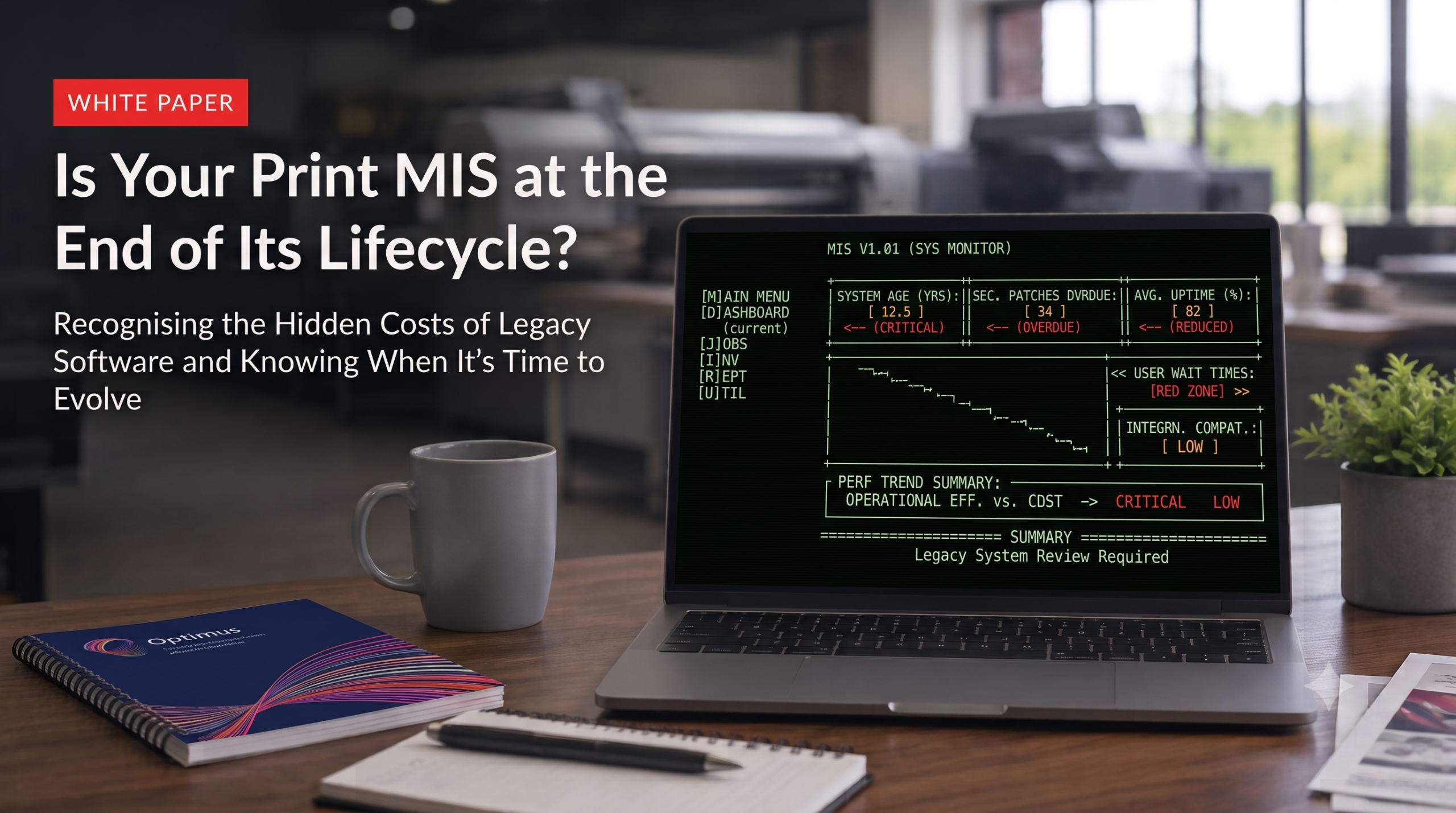
Could Your Current MIS Be Holding You Back? White Paper 2 of 7
Recognising the Hidden Costs of Legacy Software and Knowing When It’s Time to Evolve
Executive Summary
It is incredibly common for print businesses to hold onto their existing software for years. Familiarity provides comfort, and if a system has reliably run your business for a decade, moving away from it can feel unnecessary.
However, as your business grows, your technological needs naturally evolve. A Management Information System (MIS) that perfectly suited your operations five or ten years ago may now be struggling to keep pace with modern customer demands. Often, the signs are subtle at first — a slightly delayed quote here, an extra administrative step there — but over time, these small friction points can impact your competitive edge.
This white paper acts as a diagnostic tool. It will help you gently evaluate your current workflows to identify whether your existing system is simply in need of a tune-up, or if your business has officially outgrown its architecture.
1. The Natural Software Lifecycle
Every piece of software has a natural lifecycle. Eventually, older architectures mature to a point where they transition from active development into “maintenance mode.”
- The Transition to Maintenance: If it has been a significant amount of time since your system received a major feature update and recent patches have focused solely on minor bug fixes; the software may have reached its developmental peak.
- Formal Sunsetting: Occasionally, providers will issue a formal ‘Sunset’ notice indicating that a specific version of a product will no longer receive updates. This is a standard industry practice as technology companies shift their focus toward newer, cloud-based frameworks.
- Evolving Support Needs: As legacy systems age, the original developers who built the core architecture often retire or move on to new projects. If you are finding that complex support tickets take a little longer to resolve than they used to, it may simply be because the system relies on an older generation of code.
2. The Expanding Need for Connectivity
The print industry has shifted dramatically toward connected ecosystems. Ten years ago, an MIS only needed to manage internal processes. Today, modern print businesses thrive on connectivity.
- The Era of Silos: Older systems were often designed as closed environments. If your current MIS does not feature an open API, it will naturally struggle to connect to modern Web-to-Print storefronts, prepress automation tools, or contemporary accounting platforms.
- The Double-Entry Hurdle: When systems cannot speak to one another, your staff must bridge the gap. If your team is frequently copying data from customer emails into the MIS, and then re-keying that same data into your shipping or accounting software, your business is simply working harder than it needs to.
3. The Rise of Resourceful Workarounds
When an expanding business outpaces its software, employees will naturally invent creative ways to get the job done. This isn’t a failure of your team; it is a testament to their resourcefulness.
- The Spreadsheet Extension: The most common symptom of an outgrown MIS is the heavy reliance on spreadsheets. If your estimators are building complex quotes in Excel because the current MIS cannot accommodate new product lines or pricing structures, the software is no longer fully supporting their role.
- Highly Specialised Knowledge: Older systems can be complex to navigate. If only one or two veteran employees know exactly how to coax a specific report or quote out of the system, it creates a bottleneck when those individuals are out of the office.
- Reporting Confidence: Eventually, manual workarounds make it difficult to maintain a single source of truth. When leadership begins to second-guess the financial and production reports generated by the MIS, it is time to look at a more unified system.
4. Modern Standards for Speed and Security
Modernising your print business isn’t necessarily about forcing a move to the cloud; it is about finding the right technological foundation for your specific operational needs. Today’s advanced Print MIS platforms offer exceptional speed and robust data protection, whether you choose a fully hosted web environment or a modern on-premises architecture.
- The Speed of Business:Today’s print buyers expect rapid responses. If your current legacy system requires 24 to 48 hours to process and deliver a complex quote, you may find yourself at a disadvantage. Modern MIS solutions, whether deployed on your own high-performance local servers or hosted in the cloud, automate these workflows, allowing your team to turn around accurate, professional quotes in a fraction of the time.
- Shifting Security Needs:Data security and system reliability are more critical than ever, and the right hosting choice depends heavily on your internal resources. Cloud environments are excellent for businesses looking to offload the daily management of updates, backups, and threat protection to dedicated external security teams. Conversely, a modernised on-premises solution remains the ideal choice for print businesses with capable internal IT teams that require absolute control over their infrastructure, strict data sovereignty, and maximum offline reliability.
5. Weighing the Path Forward
Upgrading to a new MIS is a significant investment of time and resources. However, it is important to weigh that investment against the opportunity cost of remaining on a legacy platform.
- Lost Opportunities: Consider the revenue potential of new product lines (such as wide format or complex packaging) that you might be hesitant to take on simply because your current software cannot estimate them efficiently.
- Unlocking Your Team’s Potential: Evaluate the administrative hours your team spends navigating workarounds, searching for physical job tickets, or manually entering data. A modern system refocuses that energy on producing print and elevating customer service.
Conclusion
Holding onto legacy technology is a natural inclination, but recognising when your business has outgrown its tools is a vital step toward future growth. By thoughtfully evaluating your software’s lifecycle, your team’s daily workarounds, and your need for modern connectivity, you can make a strategic, proactive decision to upgrade before your current system limits your potential.
What’s Your Next Step? Once you make the decision to embrace a modern platform, the very next challenge is ensuring your historical data makes the journey safely.
Continue the Journey: Read the next guide in our Print MIS migration series, White Paper 3: Protecting Your Data in a Move to discover how to securely transfer and safeguard your print shop’s most valuable assets — your customer databases and pricing matrices — during a transition.
Talk to an Expert: Want to see what a modern Print MIS looks like in action? Book a Discovery Call with us to explore how a new system can seamlessly align with your evolving business goals.
Previous White Paper: Number 1 of 7 – Planning a Print MIS Migration