
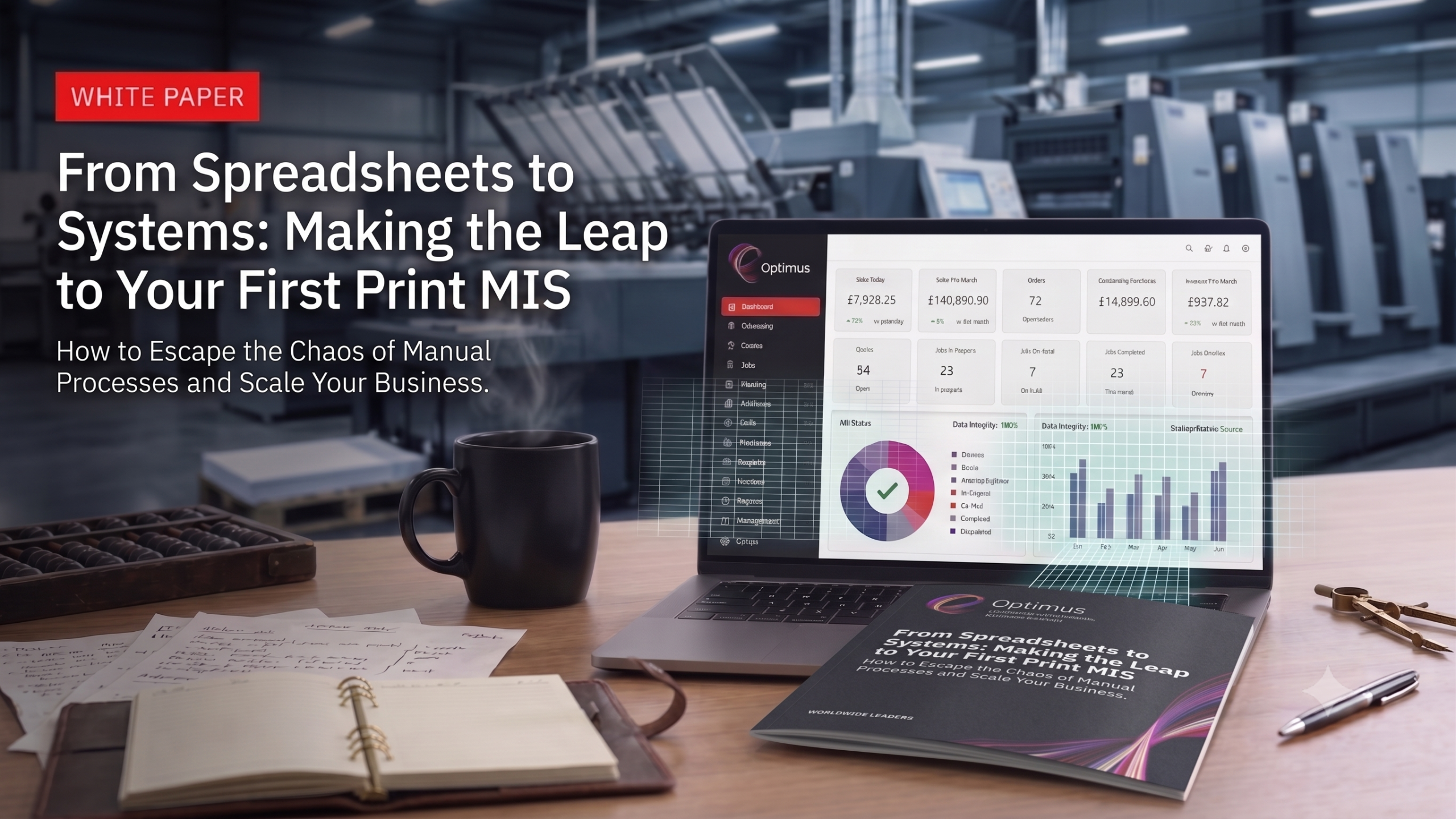
Has Your Print Business Outgrown Spreadsheets? White Paper 4 of 7
How to Escape the Chaos of Manual Processes and Scale Your Print Business
Executive Summary
Spreadsheets, whiteboards, and sticky notes are the lifeblood of many growing print shops. They are incredibly flexible, familiar to the staff, and seemingly ‘free.’ For a business just starting out, they get the job done.
However, every growing business eventually hits a tipping point where manual processes stop enabling growth and begin aggressively throttling it. Chaos on the production floor, bottlenecked quoting, and exhausted staff are the first symptoms of a business outgrowing its tools.
This white paper is designed to help you recognise your shop’s breaking point, overcome the psychological fear of adopting ‘complex’ software, and choose a foundational MIS that will help you scale without sacrificing your sanity.
1: The Hidden Cost of ‘Free’ Tools
Excel may not charge a monthly subscription fee, but it is costing your business thousands of dollars in hidden ways. The most prominent is the ‘Double-Entry Tax.’ Calculate the hours your staff wastes typing an approved quote from a spreadsheet into an email, then into a manual job ticket, and finally into an accounting system.
Furthermore, manual tools are highly susceptible to the human error factor. A single broken Excel formula or a copied-and-pasted cell can result in a massive job being sold at a loss, wiping out your profit margin for the week.
Finally, managing client communications out of personal email inboxes creates a black hole of customer service. When critical job details are locked in one person’s inbox, missed deadlines and frustrated customers are inevitable.
2: Identifying Your Breaking Point
How do you know it is time to make the leap? The most common indicator is the estimating bottleneck. If quotes are taking more than 24 hours to turn around, or if only the owner of the company knows how to price a complex job, you have definitively outgrown your tools.
Another sign is the ‘Where is My Job?’ chaos. If production managers must physically walk the shop floor to find a job ticket or check a status, your operational efficiency is actively degrading.
Lastly, look at your administrative burden. The end-of-month nightmare of trying to manually reconcile paper delivery dockets and disjointed spreadsheets just to get invoices out the door is a clear signal that you need a centralised system.
3: Overcoming the ‘Software Fear’
Many business owners resist buying an MIS due to psychological barriers. The first is the belief that ‘we are too small for an MIS.’ This is a myth. Modern software is highly scalable and implementing it while you are small ensures you have the infrastructure to handle rapid growth.
The second barrier is the fear that software is ‘too complicated.’ While legacy on-premises systems were notoriously clunky, modern cloud-based systems are intuitive and operate much like the consumer apps you use every day.
Finally, owners often fear their team will hate the change. You can overcome this by framing the new system not as a ‘Big Brother’ tracking device, but as a tool specifically designed to remove their daily headaches and eliminate tedious data entry.
4: What to Look for in Your First MIS
First-time buyers often over-purchase and quickly become overwhelmed. Your goal should be to buy what you need right now, ensuring the system has the capability to scale with you later.
Focus on the Core Foundation: rapid estimating, clear job ticketing, basic scheduling, stock management and invoice creation. These are the pillars of a functional print business.
Taking the time to truly understand your businesses unique requirements is the best way to confidently navigate the choice between cloud-native and on-premises platforms. A supportive vendor will guide you through this decision, helping you avoid the costly frustration of maintaining a system that doesn’t naturally fit your daily workflow.
Finally, to truly relieve your administrative burden, ensure your new MIS integrates seamlessly with the accounting software you already trust like Xero or QuickBooks so you can finally say goodbye to the headache of manual invoicing.
4: Building the Business Case (Measuring ROI)
A good MIS pays for itself rapidly. By turning quotes around in 30 minutes instead of 3 days, your business will win more work simply by being the first to respond to the client.
Clear, standardised digital job tickets will drastically reduce spoilage and reruns. By ensuring the right paper is loaded, and the correct finishing is applied the first time, your material costs will plummet.
The ultimate ROI, however, is freeing up the team. When the system handles the estimating and production tracking, business owners get time back to focus on high-level sales and strategy, rather than putting out daily fires on the shop floor.
Conclusion
Making the leap from spreadsheets to a centralised MIS is one of the most pivotal moments in a print business’s lifecycle. It is the moment you transition from a ‘hustle’ to a scalable operation. By choosing a system that fits your current needs and grows with you, you eliminate chaos, restore your profit margins, and finally get your time back as an owner.
Do not let the fear of change keep you tied to tools that are actively throttling your potential.
What’s Your Next Step? Getting the software is only part of the equation; getting your team to use it is another challenge entirely.
Continue the Journey: Read the next guide in our Print MIS migration series, ‘White Paper 5: Winning Hearts and Minds’ to discover proven change management strategies that will turn your most sceptical employees into the system’s biggest champions.
Talk to an Expert: Ready to see how easy modern software can be? Book a Discovery Call to see how we help growing shops ditch the spreadsheets for good.
Previous White Paper: Number 3 of 7 – Protecting Your Data in a Move