
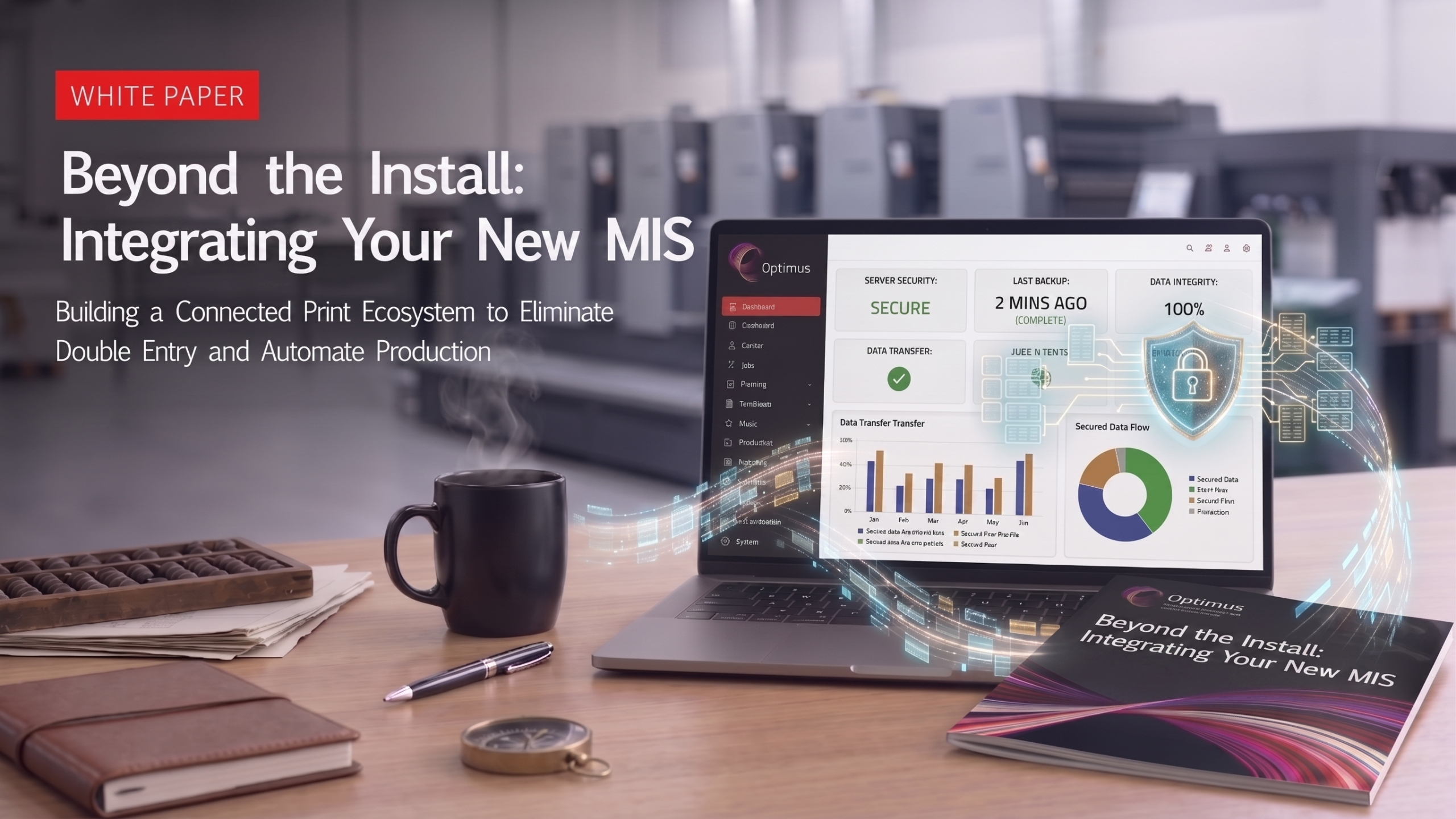
How Connected Is Your Print Business? White Paper 6 of 7
Building a Connected Print Ecosystem to Eliminate Double Entry and Automate Production
Executive Summary
Installing a new Management Information System (MIS) is a massive step toward operational efficiency, but the software cannot operate in a vacuum. In a modern print business, your MIS is the central nervous system, but it must communicate seamlessly with your website, your prepress department, your production floor, and your accounting software.
The biggest threat to your profitability is “double entry” — the act of a human being manually typing data from one software system into another. This can erode profit margins, slow down production, and increase the risk of human error.
True automation is achieved when data flows from your customer’s keyboard directly to your production equipment without being re-keyed by a member of staff.
This white paper explores how to build a connected print ecosystem around your MIS, creating a seamless flow of information from the initial online order through to production, delivery and invoicing.
1. Connecting Web-to-Print
For many modern print businesses, the customer journey begins online. Web-to-Print platforms allow customers to configure products, upload artwork, place orders and, in many cases, personalise printed material without requiring manual intervention from your sales team.
The real operational benefit comes when your Web-to-Print platform and MIS work together.
Rather than an online order creating another administrative task, integration allows order information to flow directly into the MIS. Customer details, product specifications, quantities, pricing and other relevant information can be transferred automatically, reducing the need for staff to re-key data.
Solutions such as XMPie and Flex4 can form part of this connected environment, allowing the Web-to-Print storefront to become an extension of the wider production workflow rather than an isolated sales channel.
The objective is straightforward: capture accurate information once and allow that information to move through the business.
2. Connecting Prepress and Production
Once an order enters the MIS, the next opportunity for automation lies between administration and production.
Without integration, job specifications may need to be interpreted, transferred or manually recreated within separate prepress and production systems. Every additional manual step takes time and introduces another opportunity for error.
Connecting your MIS with prepress technologies such as Enfocus and Esko can allow job information to move automatically into the next stage of the workflow.
This can include information relating to artwork, job specifications, production requirements and other workflow instructions.
The principle is not to remove people from the process. It is to remove unnecessary administration so that skilled employees can concentrate on the areas where their knowledge and judgement add the greatest value.
3. Connecting the Production Floor
Integration should not stop when a job reaches production.
A connected MIS can provide production teams with accurate, up-to-date information about what needs to be produced, when it is required and the resources needed to complete it.
Equally important is the information flowing in the opposite direction.
As work progresses, production data can be returned to the MIS, giving other areas of the business greater visibility of job status and helping management understand what is happening on the production floor.
Instead of relying on separate spreadsheets, handwritten notes or conversations to establish where a job is, the MIS becomes a central source of information.
This creates a much more connected relationship between estimating, planning, production and customer service.
4. Connecting Delivery and Accounting
The workflow does not end when production finishes.
Dispatch, delivery and accounting are equally important parts of the connected ecosystem.
Information generated during production can be used to support downstream processes, reducing further administrative duplication. Delivery information can flow into relevant shipping systems, while completed job information and material costs can be passed to accounting platforms.
Pushing completed job data and material costs directly into Xero, QuickBooks or Sage can significantly improve the efficiency of end-of-month invoicing.
Rather than finance teams manually recreating information that already exists elsewhere in the business, integration allows accurate data to continue moving through the workflow.
This helps shorten the administrative journey between completing a job, dispatching it and raising the final invoice.
5. Open APIs and an Open Approach to Integration
A connected print ecosystem depends upon software being able to communicate.
To achieve this level of automation, your MIS needs a proven open approach to integration. Open APIs provide an important digital bridge, allowing distinct pieces of software to pass data back and forth securely, alongside other established integration methods.
This becomes increasingly important as a print business evolves.
The technology you use today may not be the technology you need five or ten years from now. New production equipment, Web-to-Print platforms, prepress technologies, accounting systems and specialist applications will continue to emerge.
This flexibility becomes increasingly valuable as your technology requirements evolve. It gives you greater freedom to adopt new equipment, software and specialist applications without being constrained by a closed ecosystem.
The objective should not necessarily be to find one enormous piece of software that attempts to perform every function.
The “All-in-One” system — a single massive piece of software designed to do everything — can be replaced by a connected ecosystem in which specialist technologies work together, with the MIS providing the central operational foundation.
Conclusion
Installing an MIS is only the beginning. The greater opportunity comes from connecting it to the wider technologies that support your business.
By integrating Web-to-Print, prepress, production, delivery and accounting, you eliminate manual data entry, reduce operational bottlenecks and create a truly scalable print factory.
The goal is a connected environment in which information is captured once and flows accurately through the business.
Open APIs form an important part of that capability, but they sit within a broader requirement: your MIS needs a proven open approach to integration that gives you the freedom to connect the technologies your business needs today and in the future.
What’s Your Next Step? Once your systems are connected, the next consideration is choosing the right long-term MIS partner to support your business as it continues to evolve.
Continue the Journey: Read the final guide in our Print MIS migration series, White Paper 7: Choosing the Right Print MIS Partner to explore what to look for beyond the software itself.
Talk to an Expert: Want to explore how a connected Print MIS environment could work within your business? Book a Discovery Call with us to discuss your current workflow and integration requirements.
Previous White Paper: Number 5 of 7 – Winning Hearts and Minds: Managing Team Adoption During an MIS Move